
Lead Generation
How Much Do Facebook Ads Really Cost a Real Estate Agent? A $2,184 Case Study
By Tyler Roicki, Founder of The Herd at eXp Realty
Last updated
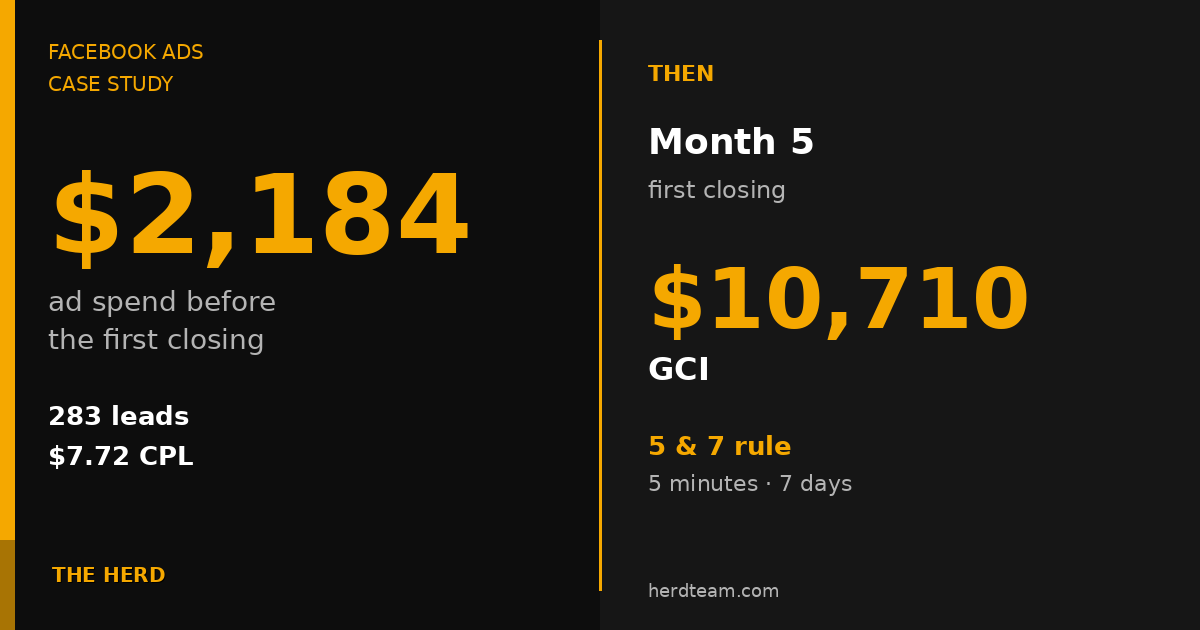
A real estate agent on our team spent $2,184 on Facebook ads before closing a single deal. It took 5 months. Then the deal that came from it paid $10,710 in gross commission, and a second closing followed a few months after that. This is the real breakdown, the actual numbers, and why most agents would have quit before it ever paid off.
The Numbers
This wasn't a test run with a small budget. Here's exactly what happened over 5 months:
- 283 leads generated
- $2,184 total ad spend
- $7.72 average cost per lead
- First closing: month 5, for $10,710 in gross commission
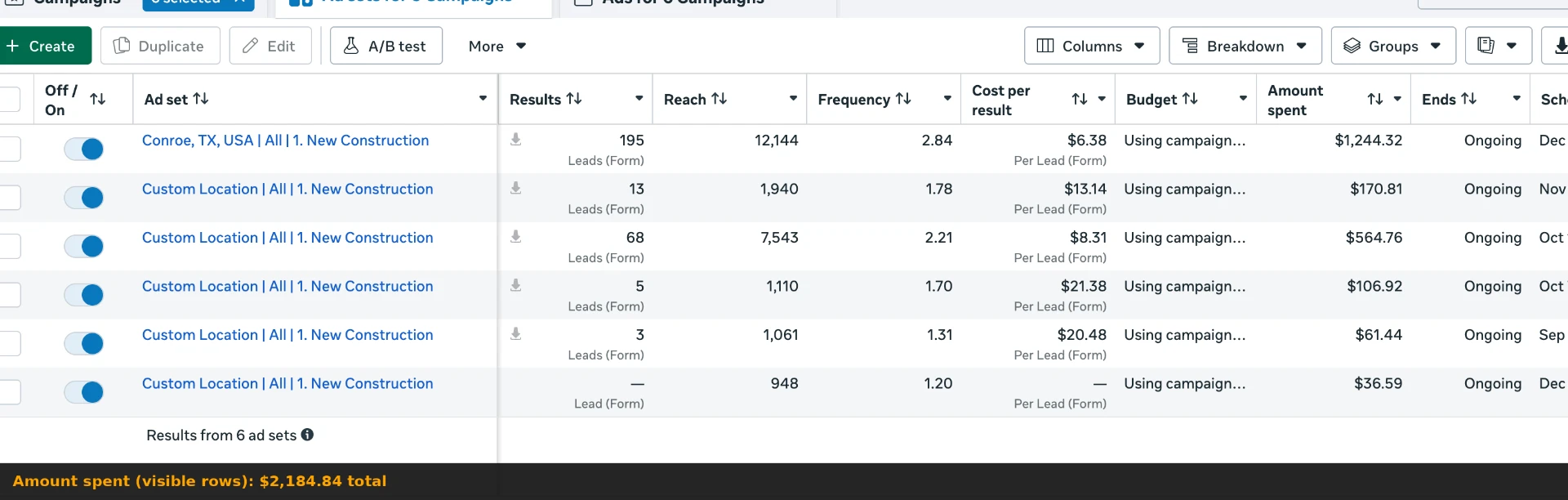
Real Ads Manager view from our new construction lead machine.
Read that timeline again. Month 1, no closings. Month 2, no closings. Month 3, no closings... by the time the first deal closed, we were well over $1,500 into ad spend with nothing to show for it on paper.
Most agents don't make it that far. And that's the actual point of sharing these numbers.
Why Most Agents Would Have Quit
If you're $1,500 in and haven't seen a result, are you still spending money on month 4? Most agents aren't... they shift to the next lead source, the next coach, the next shiny thing that promises faster results.
We kept going because we understood the math ahead of time. A pipeline takes time to build. Leads need to be contacted, nurtured, and walked through a next step. None of that happens instantly, and none of it happens for free.
Once the pipeline had momentum, the second deal came a lot faster. It took another 150 leads or so, not another 283, and it happened in a couple of months instead of 5. That's what a working system looks like once it's actually built and given time to run.
What Made the Ad Actually Work
The ad itself is only about 20% of the equation, but it still has to be built right. Here's what this one got right:
A specific, urgency-based hook. The headline centered on new construction homes in a single target area, not "homes for sale" in general. Specific beats broad every time.
One niche, one market. The ad wasn't trying to reach every buyer in the area. It targeted a single niche in a single town. Generic ads generate generic (or zero) results.
A simple, low-friction offer. The call to action was "access a list," not "schedule a meeting with me." Nobody wants to meet a stranger. Everybody wants information.
An offer, not a personality. The ad didn't sell "hire me, I'm a great agent." It sold access to new construction inventory. People raising their hand don't care who you are yet. They care about what you can show them.
The Other 80%: What Happens After the Click
Here's where almost every agent who "tries Facebook ads" actually fails. The ad brings the lead in. What happens in the next 5 minutes, and the next 7 days, determines whether that lead ever becomes a client.
Deliver on the promise immediately. If the ad said "new construction homes," the lead needs that list the second they opt in. Any delay breaks trust before the relationship even starts.
Speed to lead is everything. Leads need a call within 5 minutes, not 5 hours. The industry average response time is around 16 hours. By then, someone else already had the conversation and probably converted the client you paid for.
The first call is your one shot. This isn't a sales pitch. It's a conversation. Ask about their situation, their timeline, and how they're connected to the search. Set one clear next step. Chase mode kills conversion, so the goal is to earn a next step on that first call, not to close on the spot.
Work the lead for the first week. A $7 lead deserves more than one call and a shrug. Plan on 15 to 22 touches across call, text, and email over the first 7 days, varying the time and the angle each time.
Call it the 5 and 7 rule: contact within the first 5 minutes, work the lead hard for the first 7 days. Miss either number and the lead cools off faster than the ad spend can make up for.
Play the long game after that. A lead who doesn't convert in week one isn't a dead lead. They're just not ready yet. Life happens, timelines shift, and people go quiet instead of explaining why. A CRM and a real follow-up sequence keep you visible every single week until they are ready, not just during the first week when you're excited about the lead.
Get The Blueprint
The system behind the posts. Stop chasing random leads.
Get The Blueprint. Then exact steps you can take to grow your business, every week. Unsubscribe anytime.
How Many Leads Does It Actually Take to Get a Closing?
For a cold audience with no existing relationship, a 1% conversion rate from lead to closed deal is realistic only if your lead nurturing and follow-up are genuinely dialed in, the kind of 5 and 7 rule execution described above. Without that in place, real conversion on cold leads tends to run a lot closer to zero, even at meaningful volume. The 1% number is what's achievable with real work behind it, not a starting assumption.
Using 1% as the dialed-in benchmark: that's about 100 leads per closing. If your average commission is $10,000 and your cost per lead is $10, your client acquisition cost lands around $1,000 per deal, a trade most agents would take every time if they knew the number going in, and if their follow-up system could actually deliver that conversion rate.
The math holds up when the system behind it does. The patience, and the follow-up work, are the hard part.
The Bottom Line
Facebook ads didn't fail this agent for 4 months... the pipeline just hadn't finished building yet. The ad spend, the lead volume, and the 5-month wait for the first closing are the actual cost of building a real client acquisition system, not a shortcut around one.
If you're an agent who's tried ads before and pulled the plug at month 2 or 3, this is usually why. Not because the ads don't work, but because the system behind them never got the chance to.
So what does it actually look like when an agent has that whole system dialed in, not just the ad, but everything after it? A few of the agents inside The Herd are living proof, and their numbers are on herdteam.com.
Want the system behind this?
The Blueprint is our free operating system for real estate agents — the systems, brand, and lead flow we run inside The Herd. If you already produce and you want the next decade to compound, apply.